Isabelle Mattar — Advocating for a New Era of Museum Object Labels
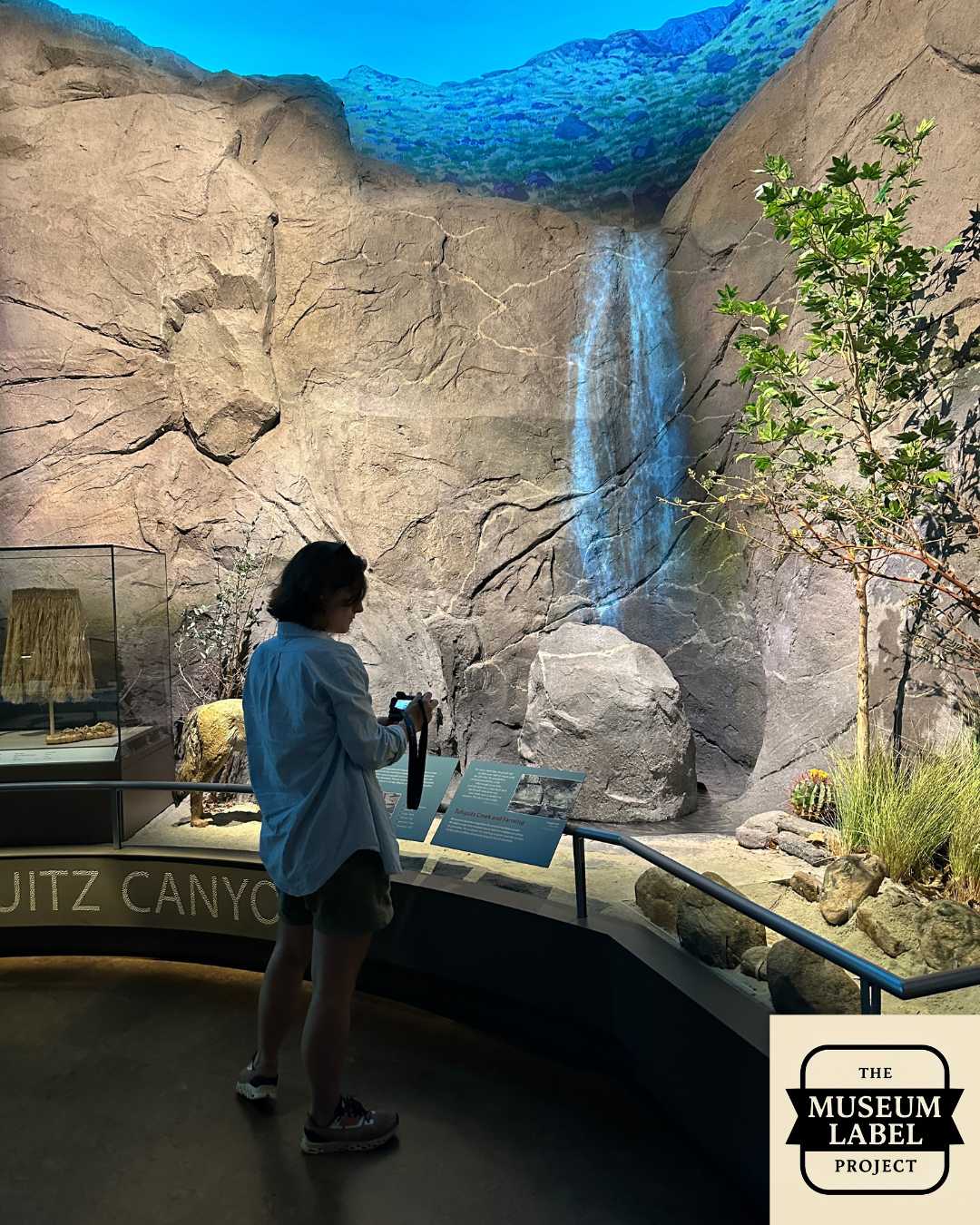
Why Labels Matter
Object labels—the little card-like tombstones next to artworks—are the most direct and intimate form of communication between a museum and its visitors. Yet, they remain one of the most underutilized tools for engagement. Too often, labels are formulaic, monotone, and quietly unhelpful. I am convinced that their very template deserves to be rethought.
Visitors disengage from labels for many reasons: cognitive overload, inaccessible language, physical layout, learning differences, or the dreaded museum fatigue. No single strategy can address every disability, learning style, or cultural expectation. Still, experimentation can bring us closer to lifting these barriers. I do not claim to know what the perfect label looks like, but I am committed to finding better models. This conviction gave rise to The Museum Label Project, a weekly article series where I experiment, observe, and advocate for labels that invite curiosity.
As a fervent museum-goer, I read object labels. Yet through the project, I have begun to wonder what labels are really doing to attract my attention. What information would make a museum visit feel meaningful, complete, or even transformative? What, even, is the purpose of visiting a museum?
Presumably, it is to learn. It can also be to encounter something new, feel inspired, or decompress. (A recent study suggested museum visits can lower stress.) Even when objects are familiar, part of the appeal lies in encountering them through new contexts or lenses. Yet if learning is central, labels frequently fail because they rely on one-way delivery, a monologue rather than dialogue. And learning, by its nature, requires engagement.
From Authority to Conversation
Traditional labels ventriloquize institutional knowledge without acknowledging the viewer’s presence, curiosity, or interpretive capacity. Their rigid structure prioritizes information over interaction, certainty over inquiry. This is not only ineffective; it is conceptually misleading.
History is not neutral. Museums are not impartial repositories of randomly assembled objects. They are curated environments, shaped by decisions about what is shown, what is emphasized, and what remains invisible. When labels adopt the tone of factual inevitability, they erase the human labor, intellectual debates, and institutional histories that produced them.
At a moment when AI increasingly flattens written voice into sterile uniformity, museums face a critical choice: replicate this monotone voice or reassert a distinct, idiosyncratic interpretive one. The next frontier of museum text, I believe, lies in defining a visible, authentic “I” or “we.” They ought to personalize the voice that speaks to and with the visitors through the labels.
And the pressure to do so should be with every label. Indeed, museums cannot expect visitors to read, be interested in, let alone retain the information on all object labels. Instead, the urgency should be: if this is the ONLY label a visitor reads, how can it transform or perhaps even transcend their museum experience?
The Birth of the Museum Label Project
This project considers all these questions seriously. I have been traveling throughout greater Los Angeles area (and occasionally beyond), visiting a wide range of institutions (not only art museums, though I am an art historian by training) to observe how museum labels function in practice. I ask: How do museums capture attention? What makes a label effective? What turns it into a barrier? How do different museum types adapt interpretation to their objects and audiences?
These modest cards possess immense potential. They can become the museum’s outstretched hand, a gentle invitation to connect, question, and linger.
Yet one pattern has remained striking: art museums often cling to narrative control. Their atmosphere of reverence borders on rigidity, turning interpretation into a kind of silent sermon. This seriousness risks transforming the visit into a multi-stop lecture rather than a dynamic space of inquiry. (In my review of the labels at LACMA, I discussed how they are written by art historians, for art historians.) By contrast, many non-art museums actively compete for attention through accessibility, playfulness, and clarity without sacrificing depth.
Another persistent barrier across institutions is the privileging of the written word. This is particularly frustrating as it resists easy resolution. While difficult to solve entirely, some museums are embracing innovation. The Museum of Ventura County and the Agua Caliente Cultural Museum, as I’ve written, experiment with multisensory strategies and conversational labels that broaden interpretive access and diversify points of entry.
The Museum Label Project itself is an injunction to lift interpretive barriers: it gathers best practices, celebrates bold experiments, and critiques persistent shortcomings. Just as importantly, it has helped me to refine my own convictions and criteria about what constitutes effective interpretation and what should be avoided.
Four Guiding Principles
Through reflection and fieldwork, I have identified four principles that anchor my approach:
- Labels should invite pause. They should serve as the starting point for personal, intellectual, or emotional engagement—not as a cultural and academic stop sign.
- Labels should empower. Labels should transform visitors into active viewers in command of their museum experience and trusting their sensorial intuition.
- Labels should open interpretation. Labels should suggest multiple ways to interpret an object. They should be open-ended and pose questions rather than dictating conclusions.
- Labels should spark curiosity. They should encourage further exploration, intrigue the viewer, and invite them to seek more information.
What I’m Learning in the Field
Voice & Presence
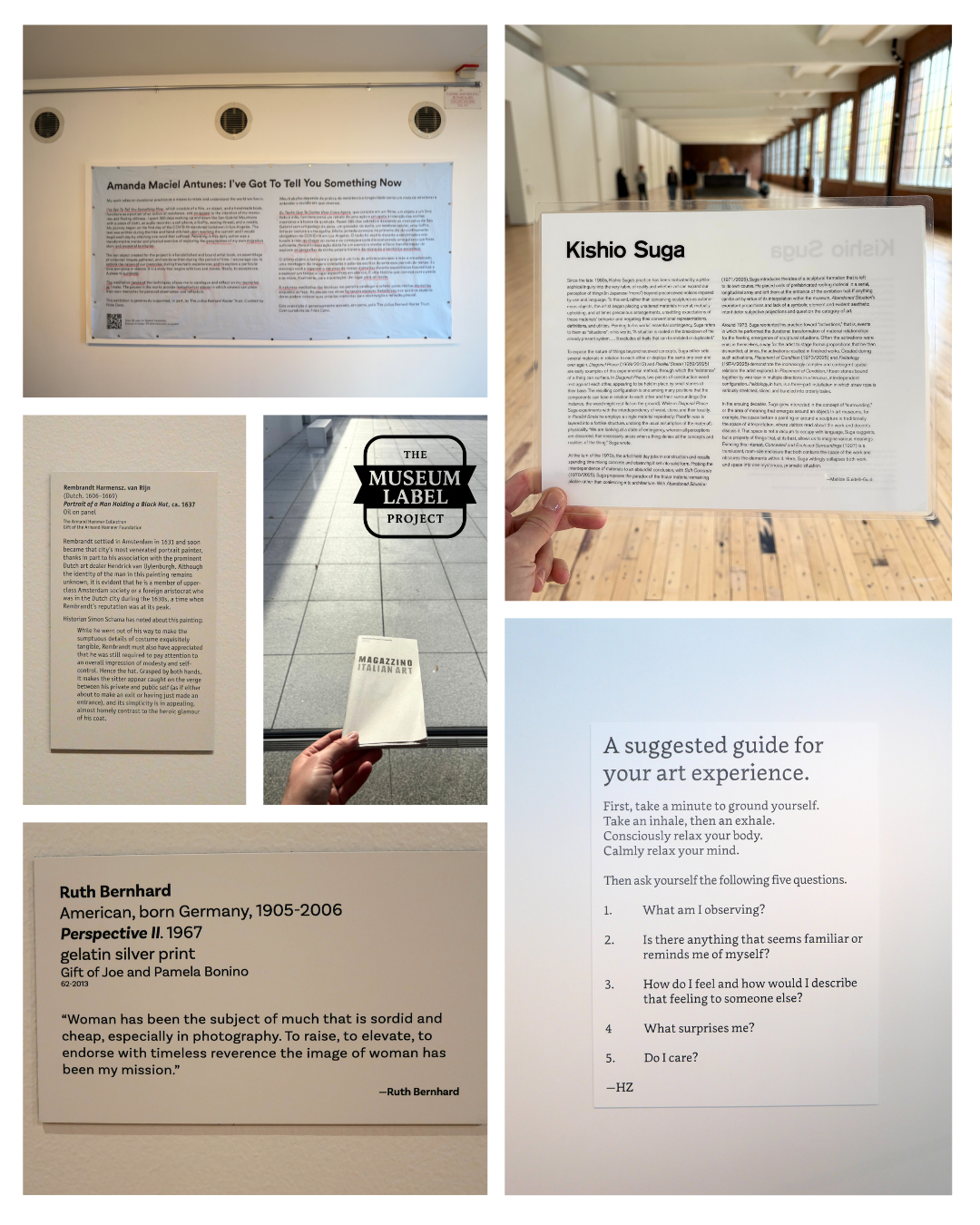
- Speak directly to visitors. At the Petersen Automotive Museum, an introductory label ends with: What do you love about cars? This simple question signals institutional passion and genuine interest in the visitor’s perspective. Similarly, the Orange County Museum of Art invites visitors to pause and ground themselves before entering, acknowledging their emotional and physical presence.
- Labels with a voice. Neutrality often collapses into blandness. Some of the most engaging labels I encountered asked questions, quoted artists, or embraced perspective. The Museum of Ventura County and Palm Springs Art Museum exemplify how varied voices can transform interpretation into conversation.
- Labels with attitude. Humor, doubt, and even subtle wit have a role in museum interpretation. At the Armory Center for the Arts, the artworks themselves brimmed with intelligence and irreverence, yet the labels neutralized this energy. Interpretation should retain some humanity: it can wink at the visitor without sacrificing rigor.
Design & Accessibility
- Vary the visuals. A poorly designed label will go unread regardless of its brilliance. Visual hierarchy, typography, spacing, and layout matter. Labels need not compete with art — they can partner with it.
- Cheap does not mean ineffective. Interpretation does not need gloss to succeed. Laminated sheets, folded pamphlets, and handwritten signage can be remarkably effective when thoughtful and placed with intention. Presence matters more than polish.
- Labels for all. Accessibility is not a checkbox, but an ongoing experiment. No label can serve every visitor, but acknowledging this gap and testing alternatives is essential. “Labels for all” means iterative design, trial and error, and input from stakeholders, not just checking a box.
Engagement & Transparency
- Break the fourth wall. Labels can demystify museum processes: how objects are acquired, conserved, or displayed. The Petersen’s explanation of its acquisition process (complete with a phone number for donations) made the institution feel transparent and navigable.
- Extend the visit beyond the building. Museums often intimidate through architecture alone. Outdoor interpretation lowers emotional thresholds and continues engagement. The La Brea Tar Pits excels in carrying interpretation seamlessly beyond its walls using clear and playful panels around the active dig sites encouraging learning even before (or after) stepping inside.
- Repeat what matters. Crucial concepts deserve repetition — across media, wording, and placement. Strategic recurrence strengthens retention. Repetition functions as both reinforcement and invitation.
- Authority with generosity. Strong interpretation balances clarity and openness. At the Agua Caliente Cultural Museum, a label in the opening gallery begins: “We are the original people of this land.” It is a bold statement of identity and authority, yet the surrounding text consistently folds visitors into the narrative through accessible language and shifts between we, you, and us—reminding readers that authority can be offered with an open hand.
Toward a More Human Label
Object labels may be small, but their power is relational. When treated as tools of dialogue rather than instruments of authority, they reshape the visitor’s role from consumer of knowledge to active participant in meaning-making.
Reimagining labels is not merely a design exercise; it is a philosophical shift. It demands that museums loosen their grip on certainty and embrace the visitor not as a passive audience, but as an interlocutor.
In that sense, the future of museum labels is not about perfection but about conversation, vulnerability, and a reciprocal curiosity—one that invites the museum to wonder alongside its visitors.
Isabelle Mattar
Isabelle (Gillet) Mattar, Ph.D. (University of Michigan, 2023), is an art historian specializing in nineteenth-century French art and museum interpretation. Based in Los Angeles, she currently works as a consultant for a private collector in addition to writing for The Museum Label Project. She also serves as an expert witness in art-related legal cases.