Erin Leary — Stewardship and Memory: Leading UMMA’s Docent Legacy Book as a Development Intern
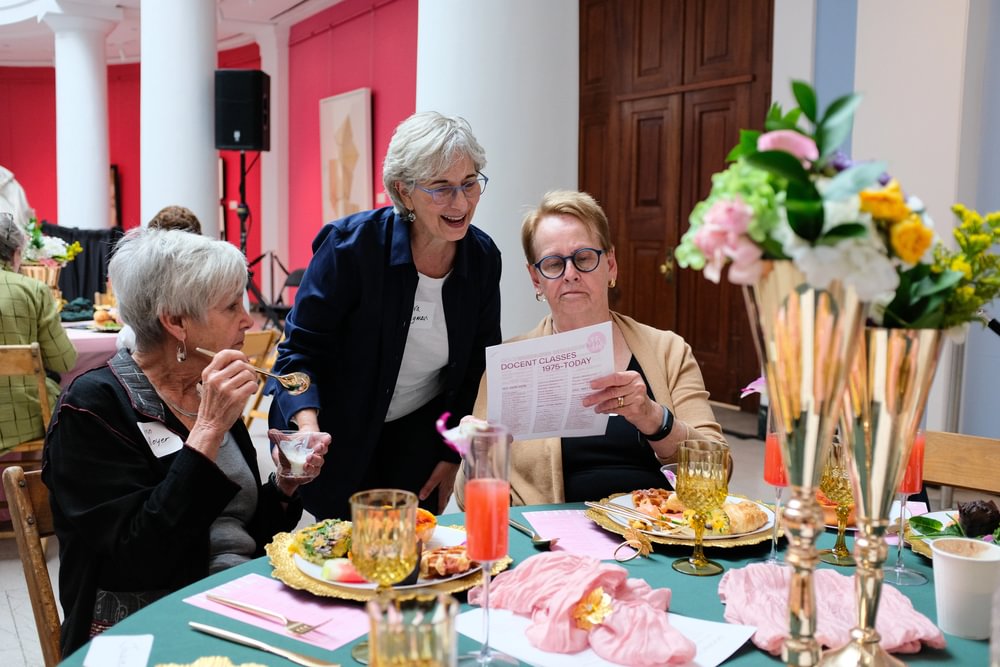
On June 2, 2025, University of Michigan’s Museum of Art’s (UMMA) Apse was dressed for the 50th and final anniversary brunch of the docent program with a careful sense of occasion. Beneath the high white columns and open balconies, the tables alternated between blush pink and deep green cloths, with the napkins reversing the pattern: pink folded onto green tables, green folded onto pink ones. Each place setting was anchored by gold plates and amber-gold stemware, while tall centerpieces rose from white vessels held in slim gold stands. The room felt composed and lush, overflowing with vibrant color, flowers, and greenery. As former docents began to arrive, the palette of pink, green, and gold gave way to movement: hugs across tables, bright conversation, laughter, and the visual distinctiveness of the docents themselves, many dressed with an ease and artistry that felt entirely at home in the museum.
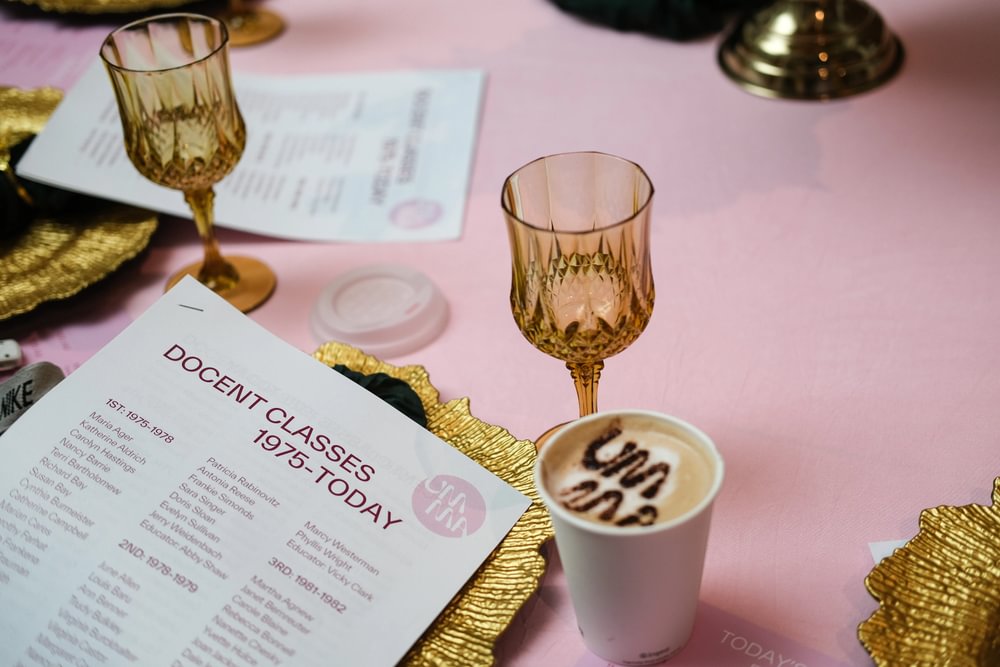
The brunch was beautiful in a way that made the day feel unmistakably marked. Platters of bright fruit and glazed pastries added more splashes of color to the room, and even the drinks extended the floral atmosphere—rows of coral-pink flutes topped with orchids. But the event did not feel ornamental or remote. It felt inhabited. What filled the space was not simply elegance, but community: the presence of people shaped by decades of shared work, memory, and affection. The program moved through remarks, reflection, live music, and a proclamation from Ann Arbor Mayor Christopher Taylor honoring fifty years of service. It was celebratory, but it was also unmistakably something else: a farewell.
While the brunch unfolded upstairs, I was stationed in the Paper Study Room on UMMA’s lower level, where I led the collection of oral histories for what would become the docent legacy book. The atmosphere there was entirely different. Instead of the openness and scale of the Apse, the room felt contained and intimate, with wood-paneled cabinetry and framed photographs creating a backdrop for each conversation. Each docent came into view differently: through a pair of softly colored glasses, a bracelet lifted in both hands, a patterned blouse, a quick laugh, or a long pause before beginning. Upstairs, the event staged a collective celebration. Downstairs, the project became individual and reflective, one voice at a time.
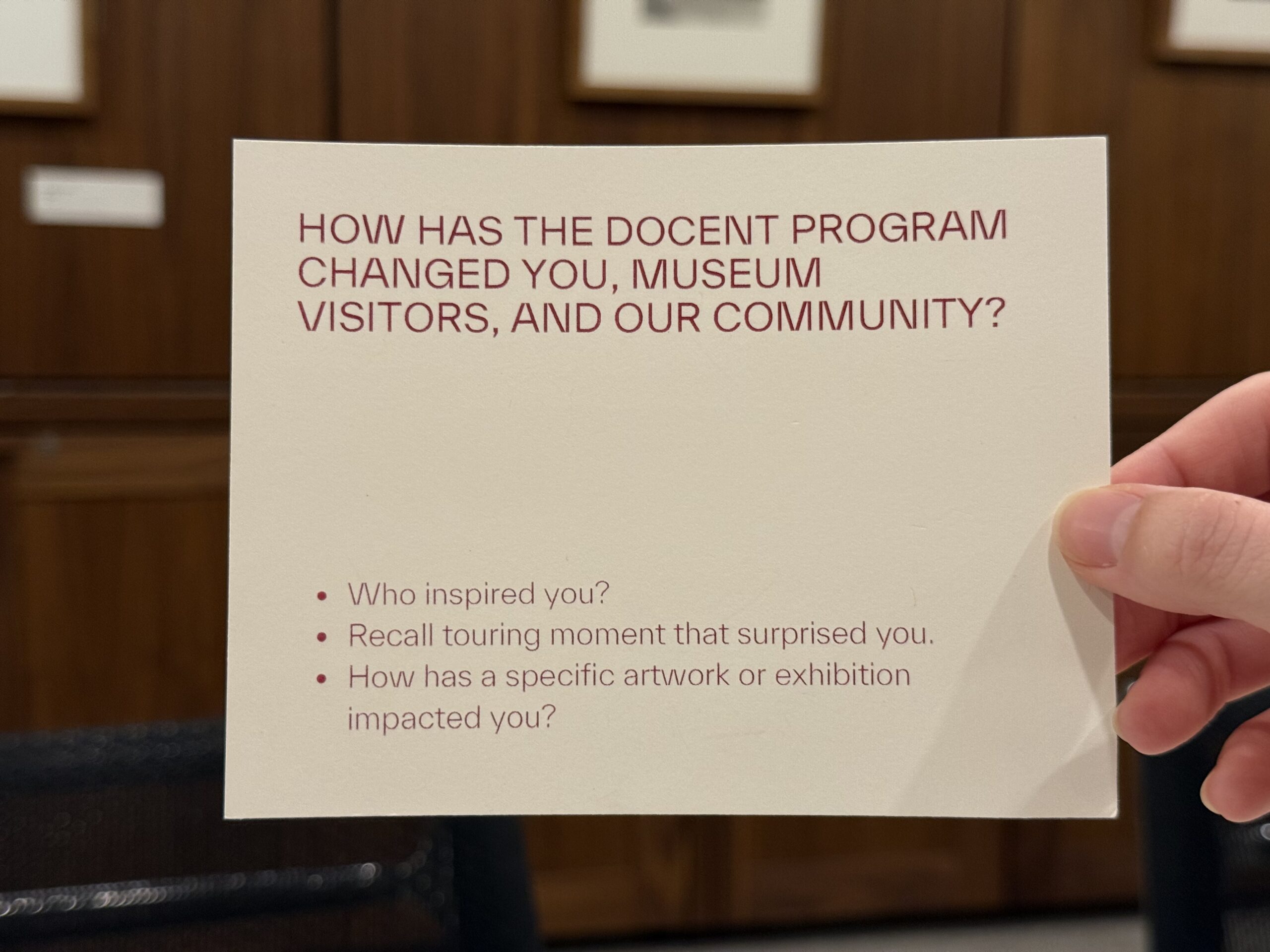
Some docents began speaking almost immediately, as if memory had been waiting just beneath the surface ready to spill out. Others sat for a moment, gathering themselves before speaking with extraordinary care about the years they had spent touring, teaching, and building relationships with the museum. What stayed with me was how visibly different memory looked from person to person. For some, recollection arrived quickly and socially, in stories that tumbled out with humor and recognition. For others, it seemed to require a kind of inward turning first, as if the right words had to be carefully lifted into the room. In the months that followed, that flow continued. Former docents emailed additional images and recollections, arranged follow-up calls, and, in some cases, worked through multiple rounds of revision as they considered how their histories—and the history of the program itself—should be represented.
That day clarified something for me. I was not simply helping document a commemorative event; I was watching a community try to preserve itself.
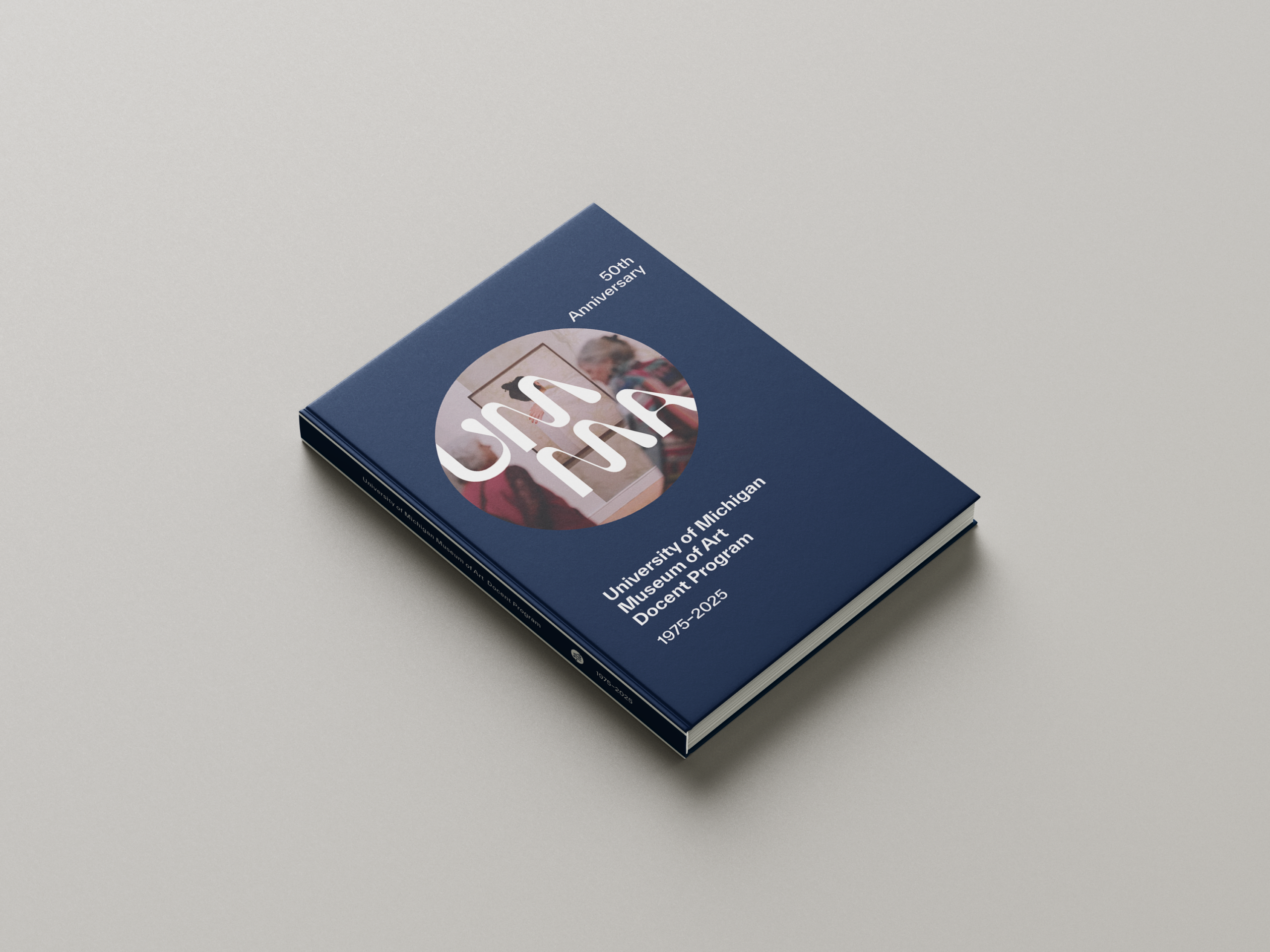
As the first Museum Studies Program intern in UMMA’s development department, I had expected to learn primarily about fundraising, donor relations, and stewardship in a more familiar sense. Instead, one of the most significant projects of my internship became a 252-page legacy book for the docent program, created through oral history, archival research, writing, image gathering, design, and cross-departmental collaboration. By the end of the process, the book had become both tribute and record: something to be distributed to former docents, preserved in the Bentley Historical Library, and made electronically accessible through Deep Blue.
What struck me from the beginning was that the project had to hold more than celebration. Established in 1975, the docent program was built as part of UMMA’s educational outreach and became a cornerstone of the museum’s public-facing teaching mission. Across five decades, docents welcomed visitors into the galleries, facilitated encounters with works of art, and helped position UMMA not only as a place to view art, but as a place to think together. At the same time, the 50th anniversary marked the program’s formal conclusion. The book therefore had to carry gratitude and grief at once. The brunch made that tension visible: reunion and recognition on the surface, but also the sadness that accompanies an ending and the uncertainty that often follows institutional change.
After the brunch, the project widened into a much larger process of research, selection, and interpretation. Over the following months, I moved among very different kinds of source material: archival boxes at the Bentley, scanned newspaper clippings, UMMA’s photo database, emailed snapshots from former docents, carefully saved personal documents, and oral histories that began as conversation and slowly became text on the page. I drafted written sections, edited images and documents for publication, and designed the book in alignment with UMMA’s written and visual identity. Eventually, I coordinated with Michigan Publishing to establish an UMMA collection in Deep Blue so that the book could have a digital afterlife as well as a printed one.
The archives revealed the rigor and reach of the program in ways I had not fully anticipated. Historical documents included in the book describe demanding training, ongoing continuing education, and sustained service expectations. They also reveal the scale of the work: hundreds of tours, thousands of visitors, and a level of volunteer commitment that was clearly central to UMMA’s educational life. A 1988 program description notes that 46 docents donated 12,000 hours in a single year, and a 1995 exhibition text reflects on more than 100,000 volunteer hours over the program’s first twenty years. Those numbers made it impossible to see the docents as peripheral to the museum’s history. They were part of the institution’s public-facing teaching mission.
The oral histories added what the archives could not. Program descriptions, news clippings, and institutional records could establish structure, chronology, and scale, but the interviews revealed the emotional and intellectual life of the program: the friendships formed through training and touring, the seriousness of the docent role as a form of teaching, the pleasure of engaging children and adults in the galleries, and the excitement of continuing to learn. Again and again, former docents described the program as a source of community, curiosity, and purpose. Their voices made clear that the history of the docent program was never only administrative. It was lived, remembered, and interpreted by the people who sustained it.
Some of the emotion surrounding the legacy project came from the nature of the transition itself. In formal oral histories, that feeling appears directly. Shira Klein recalls being “very sad to hear that the docent program was ending and that they were using professional staff instead,” even as she remained curious about how the new model would work. Laura Seligman similarly describes the moment as “an end of an era” for both herself and UMMA. Beyond the book, I also heard sadness and unease voiced plainly in conversation with docents throughout the project. Many had dedicated long periods of time, sometimes years or decades, to the program and understood its ending not simply as an organizational shift, but as the loss of a role, a rhythm, and a community that had shaped their relationship to the museum for years. At the same time, the oral histories make equally clear that the values and relationships formed through the program remain active. Again and again, docents describe lasting friendships, a continuing attachment to UMMA, and an enduring commitment to art education and public engagement. In that sense, the formal program may have ended, but its social and educational life continues in other forms.
UMMA’s transition also reflects a broader conversation in the museum field. The American Alliance of Museums (AAM) has noted a trend in institutions away from volunteer docents for guided tours and toward paid education staff, particularly where curricular, interpretive, and accountability expectations have grown more demanding. AAM has also acknowledged the larger labor questions that shape these shifts, including the difficulty of drawing a bright line between volunteer labor that enhances museum practice and unpaid labor that may influence or displace paid work. Seen in that light, the end of UMMA’s docent program was both deeply local and part of a wider professional transition. What the legacy book made visible, then, was not only the ending of a program, but the persistence of a community.
Designing the book required making choices about how legacy is represented. I did not want the project to feel like a scrapbook, but I also did not want it to read as a dry institutional history. The final structure reflects that balance. The book moves from the history of UMMA and the docent program into cohort lists, archival materials, proclamations, impact documentation, exhibition and tour photographs, K–12 programming, accessibility-centered work like Meet Me at UMMA, and written and oral histories by docents themselves. That structure allowed the publication to function as both a community artifact and a historical record. It honors the people who shaped the program while also making the program legible to future readers who may know nothing about it.
Leading this project changed the way I understood stewardship. In development, stewardship often refers to the care of relationships over time. Working on the docent legacy book expanded that definition for me. The project asked me to think about how an institution honors the people who shaped it, how it sustains relationships during a moment of transition, and how it preserves a history that might otherwise remain scattered across archives, personal collections, and memory. In that sense, the legacy book was not separate from development work. It was another form of stewardship.
That connection felt especially important because the docent program was deeply relational. It supported school groups, university classes, community organizations, and first-time visitors. It extended UMMA’s reach beyond the building and helped define the museum as a teaching museum embedded in both campus life and the broader public sphere. Preserving that history, then, was not only about commemorating a volunteer group. It was about recognizing a community whose labor helped define how the museum engaged the public for fifty years.
My position in development also shaped how I approached the project’s emotional dimensions. Some docents were eager to contribute immediately, sending photographs, letters, and stories as soon as the brunch ended. Others needed more time. Some spoke with bright energy and humor; others carried a more fragile mix of pride and sadness. Some wanted careful input on how their words or images would appear, revisiting details over multiple drafts. Others seemed most concerned that the spirit of the program—its seriousness, warmth, and sense of community—be preserved faithfully. Because many were grieving the end of the docent program and the transition to paid gallery educators, the project often felt less like a publication to assemble than a relationship to tend.
By the end of the process, I understood the book not simply as a commemorative object, but as a form of institutional care. The docent program’s ending is best understood not as closure alone, but as transition, and the values that shaped it—care, collaboration, access, and shared discovery—continue to resonate with UMMA’s mission and future. What I was preserving was not only a chronology of events, but a set of relationships, teaching practices, and public commitments that helped shape the museum over time.
Leading the docent legacy book changed the way I understand both museum work and development work. I began my internship expecting to learn how museums secure support. I left with a deeper appreciation for how museums preserve the communities that made that support, learning, and public engagement possible in the first place. The final book, now headed to former docents, the Bentley Historical Library, and UMMA’s Deep Blue repository, carries that lesson forward. It is a record of a program, but it is also an act of gratitude, stewardship, and institutional memory.
Check out a digital version of the University of Michigan Museum of Art Docent Program: 1975-2025 on Deep Blue.
Erin Leary
Erin Leary is a PhD candidate in American Culture at the University of Michigan, where she is also completing a Graduate Certificate in Museum Studies. She joined the development team at the University of Michigan Museum of Art (UMMA) as a Museum Studies Program (MSP) intern in summer 2025 and has continued working with the team since. Her MSP capstone focused on community-engaged revisions to the collections management policy at the University of Michigan Museum of Anthropological Archaeology (UMMAA). Her dissertation examines Indigenous presence, ontology, and ethical engagement in University of Michigan museums, with particular attention to UMMA.